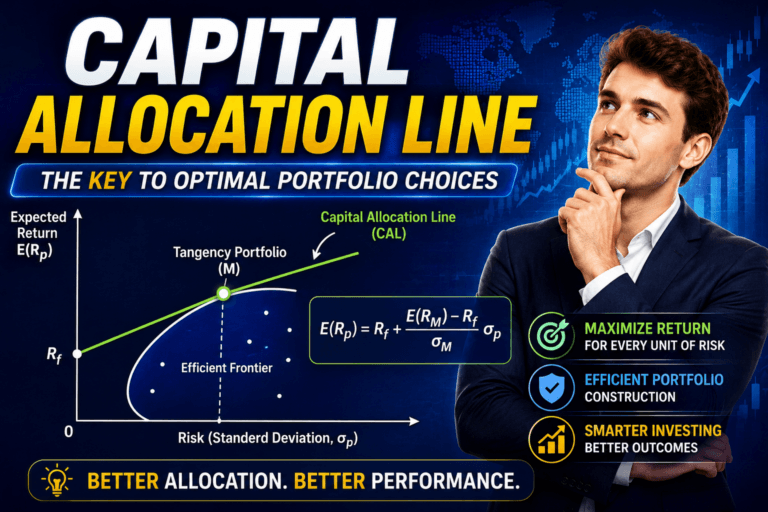
When investors build a portfolio, they usually do not put all their money in one risky asset. Some money may go into a risk-free investment, and the remaining amount may go into a risky portfolio.
The Capital Allocation Line, or CAL, helps us understand this relationship between risk and return.
In simple terms, the Capital Allocation Line shows the different combinations of a risk-free asset and a risky portfolio.
What is the Capital Allocation Line?
The Capital Allocation Line is a straight line that shows how expected return changes when an investor combines a risk-free asset with a risky portfolio.
A risk-free asset gives a fixed return with almost no uncertainty. Treasury bills are often used as an example of a risk-free asset.
A risky portfolio may include stocks, equity mutual funds, bonds, or a mix of risky investments.
The investor can decide how much money to put in the risk-free asset and how much to put in the risky portfolio.
That decision will decide the expected return and risk of the final portfolio.
Simple Example
Suppose an investor has ₹1,00,000.
There are two options:
Risk-free asset return = 5 percent
Risky portfolio expected return = 13 percent
Risky portfolio standard deviation = 20 percent
Now assume the investor puts:
60 percent in the risky portfolio
40 percent in the risk-free asset
Expected return of the complete portfolio will be:
= 40 percent × 5 percent + 60 percent × 13 percent
= 2 percent + 7.8 percent
= 9.8 percent
Portfolio risk will come only from the risky portfolio because the risk-free asset has no standard deviation.
Portfolio risk:
= 60 percent × 20 percent
= 12 percent
So, this investor has created a portfolio with an expected return of 9.8 percent and risk of 12 percent.
This point lies on the Capital Allocation Line.
Real Life Context
Think of a person who has just started investing.
They do not want to take very high risk, so they keep part of their money in a fixed-income product or Treasury bill type investment. The remaining part goes into an equity portfolio.
If the investor is conservative, they may keep more money in the risk-free asset and less in equities.
For example:
70 percent in risk-free investment
30 percent in risky portfolio
This will reduce risk, but expected return will also be lower.
On the other hand, an aggressive investor may invest more in the risky portfolio.
For example:
20 percent in risk-free investment
80 percent in risky portfolio
This can increase expected return, but the portfolio will also become more volatile.
The Capital Allocation Line simply shows these choices in a clear way.
What the Slope of CAL Shows
The slope of the Capital Allocation Line shows the extra return earned for taking extra risk.
This is also called the reward-to-variability ratio.
If the slope is steep, it means the investor is getting more return for each unit of risk.
If the slope is flat, it means the additional return for taking risk is not very attractive.
So, investors generally prefer a Capital Allocation Line with a higher slope.
Formula of Capital Allocation Line
The expected return of the complete portfolio can be written as:
Expected Return = Risk-free Rate + Weight in Risky Portfolio × Risk Premium
Where:
Risk Premium = Expected Return of Risky Portfolio – Risk-free Rate
Using the earlier example:
Risk-free rate = 5 percent
Expected return of risky portfolio = 13 percent
Risk premium = 8 percent
Weight in risky portfolio = 60 percent
Expected Return = 5 percent + 60 percent × 8 percent
Expected Return = 9.8 percent
This gives the same answer.
Why CAL is Important
The Capital Allocation Line is useful because it shows how investors can adjust their portfolio based on their risk preference.
A cautious investor may choose a point closer to the risk-free asset.
A risk-taking investor may choose a point closer to the risky portfolio.
A very aggressive investor may even borrow at the risk-free rate and invest more than 100 percent in the risky portfolio. This increases both expected return and risk.
This is why CAL is an important concept in portfolio management.
CAL vs CML
Students often confuse the Capital Allocation Line with the Capital Market Line.
The Capital Allocation Line can be drawn using any risky portfolio and a risk-free asset.
The Capital Market Line is a special case where the risky portfolio is the market portfolio.
So, every Capital Market Line is a Capital Allocation Line, but every Capital Allocation Line is not necessarily the Capital Market Line.
Final Thoughts
The Capital Allocation Line helps investors understand the trade-off between risk and return.
It shows what happens when money is divided between a risk-free asset and a risky portfolio.
The simple way to remember it is this:
The Capital Allocation Line shows how an investor can move from safety to higher return by increasing exposure to the risky portfolio.