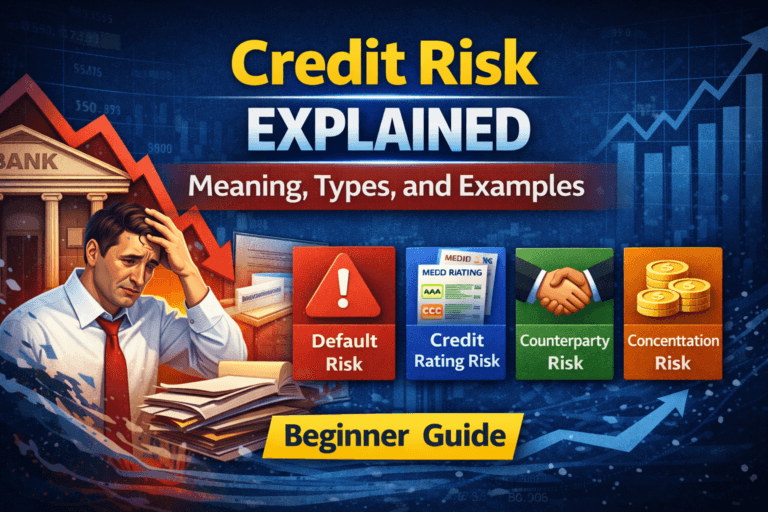
Whenever money is lent, there is always a possibility that it may not be repaid. This uncertainty is known as credit risk.
Credit risk is one of the most important concepts in finance and forms the backbone of banking and lending systems. Whether it is a bank giving loans, an investor buying bonds, or a company extending credit to customers, credit risk is always present.
In this guide, we will break down credit risk in a simple and practical way with real life examples, types, and insights.
What is Credit Risk
Credit risk is the risk that a borrower fails to repay a loan or meet their financial obligations.
👉 In simple terms
Credit risk is the risk of losing money because someone does not pay back what they owe
Why Credit Risk is Important
Credit risk is crucial because it directly impacts
Banks and financial institutions
Investors in bonds
Businesses offering credit
Overall financial stability
Example
If banks give loans without properly assessing credit risk, they may face large losses due to defaults. This can lead to financial crises.
Real Life Example of Credit Risk
Let us understand this with a simple example.
A bank gives a loan of 10 lakh to a small business.
Due to poor business performance, the company is unable to repay the loan.
The bank loses a significant portion of the money.
👉 This loss is caused by credit risk
Where Credit Risk Exists
Credit risk is present in many financial activities.
Bank loans
Corporate bonds
Credit cards
Trade credit between businesses
Even when you use a credit card, the bank is exposed to credit risk.
Types of Credit Risk
Credit risk is not just about default. It includes multiple forms of risk.
1 Default Risk
Default risk is the most basic type of credit risk.
It occurs when a borrower completely fails to repay the loan.
Example
A borrower stops paying loan installments due to financial difficulties.
2 Credit Rating Risk
This risk arises when the creditworthiness of a borrower deteriorates.
Even if the borrower does not default, their financial condition weakens.
Example
A company’s credit rating is downgraded from AAA to BBB.
This increases risk and reduces the value of its bonds.
3 Counterparty Risk
This occurs in financial transactions where one party may fail to fulfill its obligation.
It is common in derivatives and financial contracts.
Example
In a derivative contract, one party fails to make the required payment.
4 Concentration Risk
This occurs when too much exposure is given to a single borrower or sector.
Example
A bank lends a large portion of its funds to one industry.
If that industry faces a downturn, the bank faces significant losses.
Causes of Credit Risk
Credit risk arises due to multiple factors.
1 Poor Financial Health of Borrower
If the borrower has weak financials, repayment becomes uncertain.
2 Economic Conditions
During economic downturns, businesses struggle and defaults increase.
3 Lack of Proper Risk Assessment
If lenders do not evaluate borrowers properly, risk increases.
4 Over Lending
Giving too much credit without proper checks increases exposure.
How Banks Assess Credit Risk
Banks use various methods to evaluate credit risk before giving loans.
1 Credit Score
Individuals are evaluated using credit scores.
Higher score means lower risk.
2 Financial Statement Analysis
Companies are assessed based on
Revenue
Profitability
Debt levels
3 Collateral
Banks often require assets as security.
Example
Home loans are secured by property.
4 Credit Rating Agencies
Agencies like Moody’s and S&P rate companies based on risk.
How to Manage Credit Risk
Credit risk cannot be eliminated but can be managed effectively.
1 Diversification
Lending to multiple borrowers reduces overall risk.
2 Credit Analysis
Proper evaluation before lending reduces default probability.
3 Collateral Requirement
Securing loans with assets reduces potential losses.
4 Monitoring Borrowers
Regularly tracking borrower performance helps detect early warning signs.
Credit Risk vs Market Risk
Many beginners confuse these two.
Credit Risk
Loss due to borrower default
Market Risk
Loss due to market fluctuations
Example
Loan not repaid → Credit risk
Stock price falls → Market risk
Real Life Scenario
Consider two banks.
Bank A gives loans without proper checks and faces high defaults.
Bank B carefully evaluates borrowers and diversifies its loans.
Bank B performs better because it manages credit risk effectively.
Importance of Credit Risk in FRM
Credit risk is a core subject in FRM certification.
FRM teaches
How to measure credit risk
How to model default probability
How to manage exposure
Career roles include
Credit analyst
Risk analyst
Banking professional
Common Mistakes Beginners Make
Assuming all borrowers will repay
Ignoring credit ratings
Overexposure to one borrower
Not understanding risk properly
Final Thoughts
Credit risk is one of the most fundamental risks in finance. It directly affects banks, investors, and businesses.
Understanding credit risk helps in making better financial decisions, whether you are lending money, investing in bonds, or working in finance.
The key is not to avoid risk completely but to assess and manage it intelligently.
If you are preparing for FRM or building a career in finance, mastering credit risk is essential.