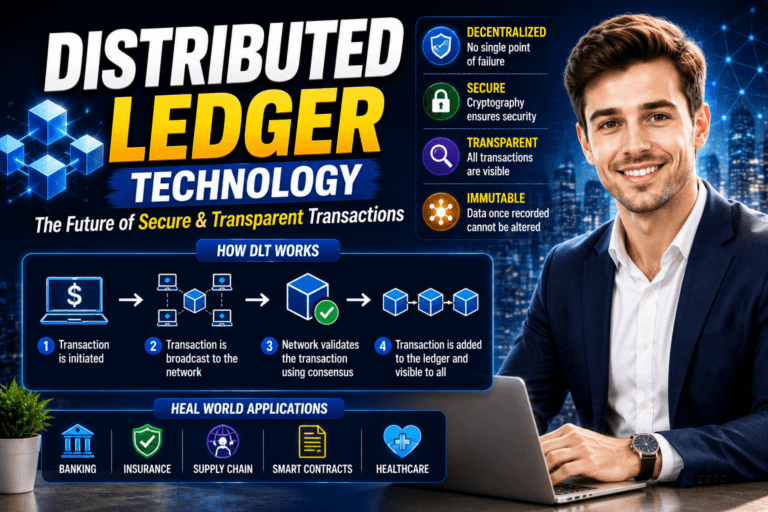
Distributed Ledger Technology, or DLT, sounds technical at first, but the basic idea is easy to understand.
It is a way of keeping records where the data is not stored in just one central system. Instead, the same record is shared across many computers in a network.
So, rather than one bank, company, or authority controlling the ledger alone, many participants can maintain and verify the same information.
What DLT Means
A ledger is simply a record of transactions or ownership.
For example, a bank keeps a record of money credited and debited from accounts. A company keeps records of sales, purchases, and payments. A government may keep records of land ownership.
In a traditional system, this record is usually maintained by one central authority.
In DLT, the record is distributed. This means many participants in the network can hold a copy of the same ledger.
Whenever a new transaction is added, the network checks and agrees that the entry is valid. Once it is recorded, changing it later becomes difficult because the change would need to match across the network.
Simple Example
Imagine five friends are going on a trip and sharing expenses.
In a normal situation, one friend may maintain all expenses in a notebook. If that notebook is lost or if someone enters the wrong amount, the group may have confusion later.
Now imagine all five friends keep the same expense record on their phones.
Whenever someone pays for food, hotel, or travel, the entry is updated for everyone. If one friend tries to change an old expense, the others can compare it with their own copies and reject the wrong change.
This is close to how DLT works.
The record is not dependent on one person. Everyone has access to the same version, and changes need agreement.
Real Life Context
One common use case of DLT is supply chain tracking.
Suppose a medicine company wants to track one batch of medicines from factory to pharmacy.
The manufacturer, transporter, warehouse, distributor, pharmacy, and regulator can all update the same shared ledger.
When the batch leaves the factory, it is recorded.
When it reaches the warehouse, it is recorded.
When it moves to the pharmacy, it is recorded.
Now, if there is a quality issue later, the company can trace the product quickly. It can see where the batch was made, where it was stored, and where it was finally sold.
This helps reduce fake records, improves transparency, and makes tracking easier.
DLT and Blockchain
Many people use DLT and blockchain as if both are the same thing, but there is a difference.
DLT is the broader concept.
Blockchain is one type of DLT.
In a blockchain, data is stored in blocks, and these blocks are linked one after another. That is why it is called a blockchain.
But every DLT system does not have to use blocks. Some distributed ledgers may use a different structure.
So, the simple way to understand it is:
Blockchain is a form of DLT, but DLT is not limited to blockchain.
Why DLT is Useful
DLT is useful when many parties need to work with the same data but do not fully want to depend on one central record keeper.
It can reduce errors because everyone is looking at the same version of records.
It can also reduce the time spent on reconciliation. In many industries, different parties maintain their own records and later compare them. This takes time and often creates disputes.
With DLT, the shared ledger can reduce this problem.
That is why DLT is discussed in banking, trade finance, capital markets, supply chains, insurance, and identity systems.
Where DLT Can Be Used
DLT can be used in payment systems, where transactions need to be recorded safely.
It can be used in trade finance, where banks, exporters, importers, and shipping companies need to verify documents.
It can be used in capital markets to record ownership of securities.
It can also be used in land records, certificates, and digital identity systems.
The common point in all these cases is that many parties need a trusted record.
Challenges of DLT
DLT is useful, but it is not required everywhere.
Sometimes a normal database is faster, cheaper, and easier to manage.
DLT also has challenges around privacy, regulation, security, and governance. If many participants are part of the network, it must be clear who can see the data, who can update it, and who is responsible if something goes wrong.
So, businesses should not use DLT only because it sounds modern. They should use it only when a shared ledger actually solves a real problem.
Final Thoughts
Distributed Ledger Technology is basically a shared digital record system.
Instead of keeping data with one central authority, the same ledger is maintained across many participants.
This can improve trust, transparency, and efficiency, especially when different parties need to rely on the same information.
The simple way to remember it is:
DLT helps different participants work with one shared version of truth.