Risk is an unavoidable part of finance. Every decision, whether it is lending money, investing in markets, or running a business, involves uncertainty.
However, successful financial institutions are not those that avoid risk, but those that manage risk effectively.
This is where the risk management process becomes critical.
In this guide, we will break down how banks and financial institutions identify, measure, control, and monitor risks in a structured way.
What is Risk Management
Risk management is the process of identifying, assessing, and controlling financial risks to minimize losses.
👉 In simple terms
Risk management is about understanding what can go wrong and taking steps to reduce its impact
Why Risk Management is Important
Risk management is essential because it helps
Protect financial institutions from losses
Ensure business stability
Maintain investor confidence
Comply with regulations
Example
If a bank does not manage risks properly, it may face large losses due to loan defaults, market crashes, or operational failures.
Types of Risks Managed
Financial institutions manage multiple types of risks.
Market risk
Credit risk
Liquidity risk
Operational risk
These risks are interconnected and require a structured approach.
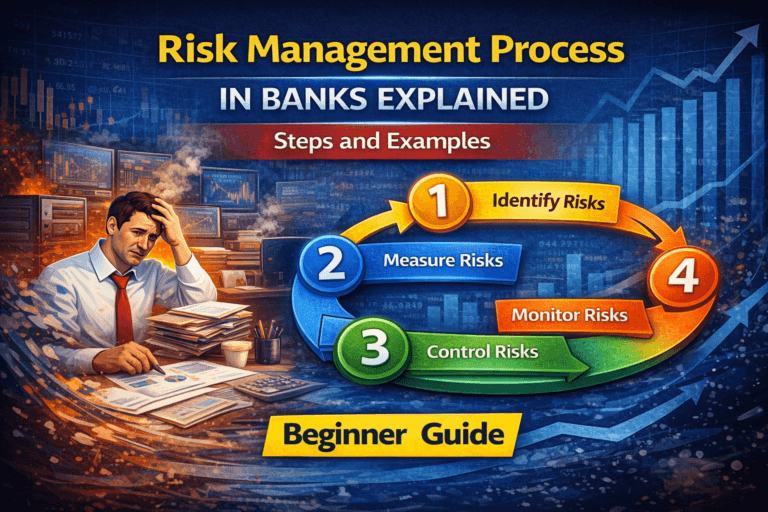
The Risk Management Process
The risk management process follows a systematic approach.
Step 1 Risk Identification
The first step is identifying potential risks.
This involves understanding what could go wrong.
Example
A bank identifies risks such as
Loan defaults
Interest rate changes
System failures
Key Insight
If risks are not identified early, they cannot be managed effectively.
Step 2 Risk Measurement
Once risks are identified, the next step is measuring them.
This helps in understanding the potential impact.
Tools Used
Value at Risk
Stress testing
Scenario analysis
Example
A bank estimates how much loss it could face if interest rates rise by 2 percent.
Key Insight
Measuring risk helps institutions prepare for worst case scenarios.
Step 3 Risk Control and Mitigation
After measuring risks, institutions take steps to reduce or control them.
Common Strategies
Diversification
Hedging
Setting exposure limits
Using collateral
Example
A bank limits the amount it lends to a single borrower to reduce concentration risk.
Key Insight
Risk cannot be eliminated, but it can be controlled.
Step 4 Risk Monitoring
Risk management is not a one time activity. Risks must be continuously monitored.
Example
Banks track
Loan performance
Market movements
Liquidity levels
Key Insight
Continuous monitoring helps detect problems early.
Step 5 Risk Reporting
Financial institutions regularly report risks to management and regulators.
Example
Risk reports include
Exposure levels
Loss estimates
Risk trends
Key Insight
Transparency is essential for effective risk management.
Real Life Example of Risk Management
Let us understand with a simple scenario.
A bank notices an increase in loan defaults.
Step 1
It identifies rising credit risk
Step 2
Measures potential losses
Step 3
Tightens lending rules
Step 4
Monitors loan performance
Step 5
Reports risk to management
This structured process helps the bank reduce losses.
Tools Used in Risk Management
Financial institutions use advanced tools.
Value at Risk (VaR)
Estimates potential loss under normal conditions
Stress Testing
Tests performance under extreme conditions
Scenario Analysis
Analyzes impact of different scenarios
Risk Management in Banks vs Companies
Banks
Focus heavily on
Credit risk
Liquidity risk
Market risk
Companies
Focus on
Operational risk
Market exposure
Cash flow management
Common Mistakes in Risk Management
Ignoring early warning signs
Overexposure to single risk
Lack of diversification
Weak monitoring systems
Importance of Risk Management in FRM
Risk management is the core of FRM certification.
FRM focuses on
Risk identification
Risk measurement
Risk control techniques
Career Roles
Risk analyst
Risk manager
Compliance officer
Treasury professional
Real Life Scenario
Consider two banks.
Bank A has a strong risk management system.
Bank B ignores risk controls.
During a financial crisis, Bank A survives while Bank B faces heavy losses.
The difference is effective risk management.
Future of Risk Management
With advancements in technology, risk management is evolving.
Use of data analytics
Artificial intelligence
Real time risk monitoring
These tools help institutions manage risks more efficiently.
Final Thoughts
Risk is an unavoidable part of finance, but it can be managed effectively with the right approach.
The risk management process provides a structured way to identify, measure, and control risks.
Whether you are an investor, a finance professional, or preparing for FRM, understanding risk management is essential.
The goal is not to eliminate risk but to manage it intelligently and strategically.