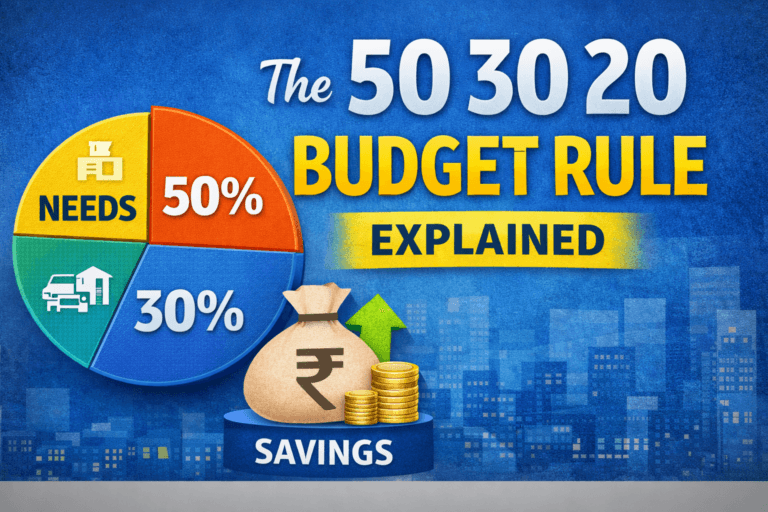
Managing money does not have to be complicated. Many people struggle with budgeting simply because they feel overwhelmed by complex financial advice. The 50 30 20 rule offers a simple and practical framework that helps individuals manage their income, control spending, and build savings without complicated calculations.
This budgeting rule divides your income into three clear categories: needs, wants, and savings. By following this structure, individuals can create a balanced financial plan that supports both current lifestyle and future financial security.
What is the 50 30 20 Budget Rule
The 50 30 20 rule is a simple budgeting method that divides your after tax income into three parts.
50 percent for needs
30 percent for wants
20 percent for savings and investments
This framework helps people maintain a balance between essential expenses, lifestyle spending, and long term financial planning.
The rule was popularized by Elizabeth Warren, a US senator and financial expert, in her book on personal finance.
Understanding the Three Budget Categories
To use the 50 30 20 rule effectively, it is important to clearly understand the three categories.
1 Needs 50 Percent of Income
Needs include all essential expenses required for daily living and financial obligations. These are expenses you cannot easily avoid.d
Common examples include
Rent or home loan payments
Groceries
Utilities such as electricity and water
Transportation costs
Insurance premiums
Minimum debt payments
Example
Suppose Priya earns 80000 per month after taxes.
According to the rule
Needs budget = 50 percent of income
Needs allocation
80000 x 50 percent = 40000
Priya’s essential expenses might look like this
Rent: 20000
Groceries: 6000
Transportation: 4000
Utilities: 3000
Insurance: 3000
Loan payment: 4000
Total needs spending: 40000
By keeping her essential expenses within this limit, Priya ensures that she does not overspend on necessities.
2 Wants 30 Percent of Income
Wants include discretionary spending that improves lifestyle but is not essential for survival.
Examples include
Dining out
Entertainment subscriptions
Travel
Shopping
Gym memberships
Streaming services
These expenses make life enjoyable but can easily grow out of control without a spending limit.
Example
Priya allocates 30 percent of her income to wants.
80000 x 30 percent = 24000
Her lifestyle spending might look like
Dining out: 6000
Shopping: 7000
Entertainment and subscriptions: 3000
Weekend activities: 4000
Travel savings: 4000
Total wants spending: 24000
This allows Priya to enjoy her lifestyle without compromising her financial stability.
3 Savings and Investments 20 Percent of Income
The final 20 percent of income should be allocated toward building financial security and long term wealth.
This category includes
Emergency fund savings
Retirement savings
Mutual fund investments
Stock investments
Debt repayment beyond minimum payments
Example
Priya allocates 20 percent of her income to savings.
80000 x 20 percent = 16000
Her allocation might include
Mutual fund SIP: 8000
Emergency fund savings: 5000
Stock investments: 3000
Over time, consistent savings and investments can significantly grow wealth.
Why the 50 30 20 Rule Works
This rule is effective because it creates a clear balance between spending and saving.
Many people either overspend on lifestyle expenses or save too little for the future. The 50 30 20 framework prevents both extremes.
Key benefits include
Simple structure that is easy to follow
Encourages disciplined spending
Ensures consistent savings
Maintains financial balance
It is particularly useful for individuals who are new to budgeting.
Real Life Example of the 50 30 20 Rule
Let us consider another example.
Aman earns 60000 per month after taxes.
Using the 50 30 20 rule
Needs 50 percent = 30000
Wants 30 percent = 18000
Savings 20 percent = 12000
His budget may look like
Needs
Rent: 15000
Groceries: 5000
Transportation: 3000
Utilities: 2000
Insurance: 3000
Loan payment: 2000
Wants
Dining out: 5000
Shopping: 6000
Entertainment: 3000
Travel fund: 4000
Savings
Emergency fund: 5000
Mutual fund SIP: 5000
Stock investments: 2000
By following this framework, Aman ensures that his finances remain structured and sustainable.
When the 50 30 20 Rule May Need Adjustment
While this rule works well for many people, it may need adjustments depending on personal circumstances.
For example
In expensive cities, housing costs may exceed 50 percent of income.
Individuals with large education loans may allocate more than 20 percent toward debt repayment.
High income individuals may choose to save more than 20 percent.
The rule should be treated as a guideline rather than a strict rule.
Tips to Implement the 50 30 20 Rule Successfully
Start by tracking all monthly expenses
Identify which expenses fall into each category
Reduce unnecessary wants if savings are too low
Automate savings transfers each month
Review and adjust spending regularly
Small adjustments can make a significant difference over time.
Final Thoughts
The 50 30 20 rule offers a simple yet powerful way to manage personal finances. By dividing income into needs, wants, and savings, individuals can create a balanced financial plan that supports both present lifestyle and future financial goals.
The key to success is consistency. Even small savings contributions made regularly can grow significantly over time.
For beginners in personal finance, this rule provides a practical starting point for building healthy financial habits.