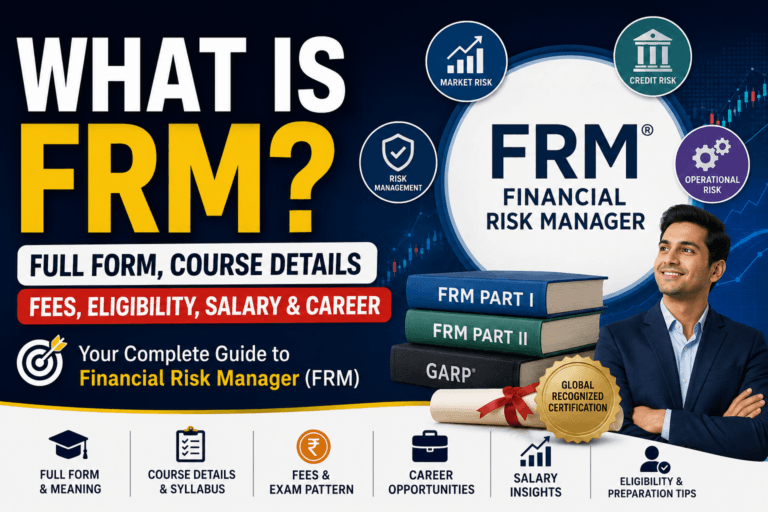
Quick Answer: What Is FRM?
FRM stands for Financial Risk Manager. It is a professional certification awarded by the Global Association of Risk Professionals, commonly known as GARP. The program develops knowledge of market risk, credit risk, operational risk, liquidity risk, financial products, quantitative analysis and risk modelling.
To earn the FRM certification, a candidate must pass FRM Part I and Part II and submit evidence of at least two years of relevant full-time professional experience.
Comprehensive Summary of FRM
| FRM detail | Information |
|---|---|
| FRM full form | Financial Risk Manager |
| Certification provider | Global Association of Risk Professionals |
| Number of exam parts | Two |
| FRM Part I format | 100 multiple-choice questions |
| FRM Part II format | 80 multiple-choice questions |
| Exam delivery | Computer-based testing |
| Exam months | May, August and November |
| Educational prerequisites | None required for registration |
| Work experience requirement | Two years of relevant full-time experience |
| Typical preparation time | Around 240 hours per part, although individual requirements vary |
| Main subject areas | Quantitative analysis, financial markets, valuation, market risk, credit risk, operational risk and liquidity risk |
| Career relevance | Banking, risk analysis, treasury, consulting, model validation, investment management and related fields |
GARP currently offers FRM examinations during May, August and November. The official program consists of two computer-based multiple-choice examinations.
Key Takeaways
- FRM is a specialised financial risk management certification awarded by GARP.
- The program consists of FRM Part I and FRM Part II.
- There are no formal educational or professional prerequisites for registering.
- Passing both examinations alone does not immediately make someone FRM-certified.
- Candidates must also complete and submit two years of relevant full-time work experience.
- FRM Part I focuses on foundational tools, while Part II focuses on applying those tools to different risk categories.
- GARP states that candidates typically invest around 240 hours of preparation over several months for each examination part.
- The certification is relevant to careers in risk analysis, banking, treasury, consulting, model validation and investment management.
What Is the FRM Full Form?
The full form of FRM is Financial Risk Manager.
The term refers both to the professional certification program and to an individual who has completed all certification requirements established by GARP.
It is important to distinguish between three different descriptions:
FRM Candidate
An FRM candidate is a person who has registered for or is preparing for one of the examinations.
FRM Exam Passer
A person who passes Part I or both parts may state that they have passed the relevant examinations. However, passing the examinations alone does not automatically grant the right to use the FRM designation.
FRM-Certified Professional
A candidate becomes FRM-certified only after:
- Passing FRM Part I
- Passing FRM Part II within the permitted period
- Submitting two years of relevant full-time professional experience
- Receiving approval from GARP
Candidates cannot use the FRM designation after their name until the certification requirements have been completed and approved.
Who Awards the FRM Certification?
The Financial Risk Manager certification is awarded by the Global Association of Risk Professionals.
GARP is a professional association focused on risk management education, certification and professional development. It describes FRM as a globally recognised standard for professionals who manage financial risk.
GARP reported reaching more than 100,000 FRM-certified professionals worldwide in 2026.
The organisation is responsible for:
- Defining the FRM curriculum
- Publishing official learning objectives
- Administering FRM examinations
- Establishing certification requirements
- Reviewing professional experience submissions
- Maintaining examination policies
- Revising the curriculum to reflect developments in financial risk management
The FRM curriculum is reviewed annually under the direction of the GARP FRM Committee. This helps the program remain aligned with the knowledge and skills required in financial risk roles.
Why Does the FRM Certification Exist?
Financial institutions operate in environments where unexpected losses can arise from changes in market prices, borrower defaults, operational failures, liquidity shortages, model errors and broader financial disruptions.
Risk management professionals help organisations understand these exposures before they become unmanageable.
The FRM program exists to develop a structured understanding of:
- How financial risks arise
- How risks can be identified
- How exposures can be measured
- How organisations monitor risk
- How financial models support decisions
- How institutions establish risk limits
- How risk information is communicated
- How risk interacts with investment and business decisions
FRM is not limited to learning formulas. The program connects quantitative methods with financial products, governance, market behaviour and real organisational decisions.
What Does a Financial Risk Manager Do?
A financial risk professional identifies, measures, monitors and helps manage risks that may affect an organisation.
The exact responsibilities depend on the role, employer and risk specialisation.
Common responsibilities may include:
- Measuring exposure to interest rates, currencies and market prices
- Assessing the probability of borrower or counterparty default
- Evaluating operational failures and control weaknesses
- Monitoring liquidity and funding requirements
- Reviewing risk models and assumptions
- Preparing stress tests and scenario analyses
- Establishing risk limits
- Producing reports for senior management
- Supporting regulatory compliance
- Evaluating risks in investment portfolios
- Communicating financial risks to decision-makers
GARP recognises relevant experience across areas such as risk analysis, model validation, trading, portfolio management, treasury, audit and consulting, provided that identifying, measuring, monitoring or managing risk is a meaningful part of the role.
Who Should Consider the FRM Course?
FRM may be relevant for people interested in careers where financial uncertainty, financial markets and business decisions intersect.
The program may suit:
Finance Students
Students studying finance, accounting, commerce, economics or business may use FRM to develop specialised risk knowledge.
Engineering and Mathematics Students
Students with quantitative backgrounds may find the statistical and analytical parts familiar, although they may need additional preparation in financial markets and products.
Working Professionals
Professionals in banking, audit, treasury, consulting, investments, insurance or financial technology may pursue FRM to deepen their understanding of risk.
CFA Candidates and Charterholders
FRM may complement investment knowledge by adding deeper coverage of market, credit, operational and liquidity risk.
Career Switchers
Professionals seeking to move into financial risk may use the curriculum to build foundational knowledge. However, certification does not by itself guarantee a career transition.
Non-Finance Graduates
A finance degree is not required for registration. Non-finance candidates should be prepared to spend additional time developing knowledge of financial instruments, statistics and valuation.
What Are the FRM Eligibility Requirements?
There are no formal educational or professional prerequisites for enrolling in the FRM program.
A candidate does not need:
- A specific university degree
- A finance qualification
- A minimum number of professional years
- Previous work experience
- A particular academic stream
Students and working professionals can register for FRM Part I when they feel ready to begin preparation.
However, the absence of formal prerequisites does not mean the examinations are basic.
A candidate will benefit from familiarity with:
- Basic algebra
- Probability
- Statistics
- Economics
- Financial markets
- Time value of money
- Bonds and derivatives
- Spreadsheet-based analysis
Candidates without this background can still prepare, but they may need to build these foundations before progressing to advanced topics.
Can a College Student Register for FRM?
Yes. GARP does not require candidates to complete a university degree before registering.
A college student may register for FRM Part I and begin preparing while completing their academic studies. GARP also notes that combining FRM knowledge with disciplines such as accounting, computer science, data analytics, economics, engineering, finance or statistics can be valuable when applying for roles inside and outside risk management.
Students should nevertheless consider whether they have sufficient time for:
- University coursework
- FRM lectures or self-study
- Practice questions
- Revision
- Mock examinations
- Career development activities
Registering early is useful only when the candidate can follow a realistic preparation plan.
How Do You Become FRM-Certified?
Becoming FRM-certified requires more than passing two examinations.
Step 1: Register for FRM Part I
The candidate creates a GARP account, completes registration and pays the applicable examination and enrolment fees.
Step 2: Prepare for FRM Part I
Part I develops the tools used to understand and measure financial risk.
Step 3: Pass FRM Part I
Candidates must pass Part I before their Part II result can count toward certification.
Step 4: Register for and Pass FRM Part II
Part II focuses on applying risk management tools to market risk, credit risk, operational risk, liquidity risk and investment management.
Candidates must pass Part II by December 31 of the fourth year after passing Part I.
Step 5: Complete Relevant Work Experience
Candidates need at least two years of relevant full-time professional experience.
The work should involve financial risk identification, measurement, monitoring or management in a meaningful way.
Relevant roles may include:
- Risk analysis
- Model validation
- Trading
- Portfolio management
- Treasury
- Audit
- Consulting
- Other finance and quantitative roles involving risk
Internships, part-time positions and experience completed during school do not count toward the official experience requirement.
Step 6: Submit Work Experience to GARP
Candidates currently have up to ten years after passing Part II to submit their professional experience.
Experience completed within the ten years before passing Part II may also be considered, provided it meets the relevance and full-time requirements.
Step 7: Receive Certification Approval
After GARP approves the experience submission, the candidate becomes eligible to use the FRM designation.
How Many Levels Are There in FRM?
The FRM program contains two examination parts:
- FRM Part I
- FRM Part II
They are commonly called levels, although GARP officially refers to them as examination parts.
What Is FRM Part I?
FRM Part I establishes the analytical and financial foundations required to understand risk.
It consists of 100 equally weighted multiple-choice questions delivered through computer-based testing.
The four main knowledge areas are:
- Foundations of Risk Management
- Quantitative Analysis
- Financial Markets and Products
- Valuation and Risk Models
Foundations of Risk Management
This area introduces the purpose and structure of financial risk management.
Candidates study topics such as:
- Types of financial risk
- Risk governance
- Corporate governance
- Risk appetite
- Risk culture
- Financial disasters and lessons
- Roles and responsibilities of risk managers
- Portfolio risk principles
- Capital allocation
This subject helps candidates understand why institutions manage risk and how risk management fits into organisational decision-making.
Quantitative Analysis
Quantitative Analysis covers the mathematical and statistical tools used to study uncertainty.
Topics commonly include:
- Probability
- Random variables
- Statistical distributions
- Sampling and estimation
- Hypothesis testing
- Correlation
- Regression
- Time-series analysis
- Volatility
- Simulation
- Data analysis
This area can be challenging for candidates without a quantitative background. The objective is not only to remember equations but also to understand when and why a particular method should be used.
Financial Markets and Products
This section introduces financial instruments and the markets in which they trade.
Candidates learn about:
- Bonds
- Equities
- Foreign exchange
- Commodities
- Futures
- Forwards
- Options
- Swaps
- Mortgage-related products
- Interest-rate instruments
- Financial institutions
- Market structures
Risk cannot be measured properly without understanding the financial products that create the exposure.
Valuation and Risk Models
This area connects valuation methods with risk measurement.
Topics may include:
- Bond valuation
- Duration and convexity
- Option valuation
- Volatility
- Value at Risk
- Expected Shortfall
- Stress testing
- Scenario analysis
- Credit risk models
- Model performance
- Model risk
Part I gives candidates the technical foundation required for the application-focused subjects in Part II.
What Is FRM Part II?
FRM Part II focuses on applying the concepts and tools introduced in Part I.
It contains 80 equally weighted multiple-choice questions and is delivered through computer-based testing.
The main areas are:
- Market Risk Measurement and Management
- Credit Risk Measurement and Management
- Operational Risk and Resilience
- Liquidity and Treasury Risk Measurement and Management
- Risk Management and Investment Management
- Current Issues in Financial Markets
Market Risk Measurement and Management
Market risk is the possibility of loss caused by changes in market variables.
These variables may include:
- Interest rates
- Equity prices
- Foreign-exchange rates
- Commodity prices
- Credit spreads
- Volatility
Candidates study how institutions measure, model and manage these exposures.
Credit Risk Measurement and Management
Credit risk is the possibility that a borrower, issuer or counterparty may fail to meet a financial obligation.
Topics include:
- Probability of default
- Loss given default
- Exposure at default
- Credit ratings
- Counterparty risk
- Credit derivatives
- Portfolio credit risk
- Credit risk mitigation
Operational Risk and Resilience
Operational risk arises from failures involving people, processes, systems or external events.
Examples include:
- Internal fraud
- Cyberattacks
- Technology failures
- Process errors
- Legal events
- Business disruptions
- Third-party failures
Operational resilience focuses on the ability of an organisation to continue delivering important services during disruptions.
Liquidity and Treasury Risk
Liquidity risk arises when an institution cannot meet financial obligations without incurring unacceptable losses.
This area may include:
- Funding liquidity
- Market liquidity
- Cash-flow management
- Liquidity stress testing
- Asset and liability management
- Contingency funding
- Treasury risk
Risk Management and Investment Management
This area considers how risk principles influence portfolios and investment decisions.
Topics may include:
- Portfolio construction
- Risk-adjusted performance
- Hedge fund risk
- Portfolio risk budgeting
- Factor models
- Investment risk monitoring
Current Issues in Financial Markets
This section examines current and emerging issues that affect financial risk.
The topics can change from year to year because GARP revises the curriculum annually. Candidates should therefore use the official learning objectives and study guide for their examination year rather than relying on older summaries.
What Is the FRM Exam Pattern?
| Exam feature | FRM Part I | FRM Part II |
|---|---|---|
| Number of questions | 100 | 80 |
| Question type | Multiple choice | Multiple choice |
| Delivery | Computer-based | Computer-based |
| Primary focus | Risk tools and foundations | Application of risk tools |
| Main difficulty | Quantitative and conceptual foundations | Applied and integrated risk decisions |
| Sequence | Must be passed first | Completed after Part I |
Both examinations assess understanding, interpretation and application.
The examination is quantitative, but it is not purely a mathematics test. GARP states that the mathematical difficulty is consistent with an advanced undergraduate or introductory graduate finance course.
Candidates must know how to use important formulas because formula sheets are not provided during the examination.
When Are FRM Exams Conducted?
GARP offers FRM examinations during:
- May
- August
- November
The exact testing windows vary by year and examination part. Seats are provided on a first-come, first-served basis, so candidates should register and schedule their chosen test location within the official deadlines.
For example, the November 2026 testing windows are:
- FRM Part I: November 14 to November 20, 2026
- FRM Part II: November 21 to November 25, 2026
These dates can change in future examination cycles. Candidates should confirm the current schedule directly through GARP before registration.
How Much Time Is Needed to Prepare for FRM?
GARP states that candidates typically invest approximately 240 hours over several months in preparation. The actual requirement depends on the individual.
A candidate may need more or less time based on:
- Educational background
- Finance knowledge
- Mathematical comfort
- Work schedule
- Reading speed
- Previous risk experience
- Quality of practice
- Revision discipline
- Mock examination performance
A finance professional who already understands derivatives and quantitative analysis may move faster than a beginner.
A non-finance candidate may need additional preparation time for:
- Financial terminology
- Basic statistics
- Market instruments
- Valuation
- Risk models
The number of study hours matters, but the quality and consistency of those hours matter more.
Is FRM Mathematically Difficult?
FRM contains a meaningful amount of quantitative material, particularly in Part I.
Candidates may encounter:
- Probability
- Statistics
- Regression
- Time-series analysis
- Valuation
- Interest-rate calculations
- Derivatives
- Risk models
- Simulation
- Portfolio mathematics
However, candidates are not expected to prove every mathematical result from first principles.
They need to:
- Understand what a formula measures
- Recognise the appropriate formula
- Apply it correctly
- Interpret the result
- Connect the result with a risk decision
GARP describes the mathematical level as comparable to an advanced undergraduate or introductory graduate-level finance course.
Is FRM Suitable for Beginners?
Yes, a beginner can pursue FRM, but beginning directly with advanced questions may create unnecessary difficulty.
A beginner should first become comfortable with:
- Time value of money
- Basic probability
- Mean and variance
- Correlation
- Regression fundamentals
- Bonds
- Futures
- Options
- Financial statements
- Market terminology
A structured foundation can make the official FRM curriculum easier to understand.
The key challenge for beginners is not intelligence. It is building several connected concepts in the correct sequence.
Part 1 Summary
FRM is a specialised professional certification in financial risk management. It is administered by GARP and consists of two computer-based examinations.
Part I builds the foundation through quantitative analysis, financial markets, valuation and risk models. Part II applies these tools to market risk, credit risk, operational risk, liquidity risk, investment management and current financial issues.
There are no formal registration prerequisites, but candidates must pass both examination parts and submit two years of relevant full-time work experience before using the FRM designation.
What Is the FRM Course Duration?
One of the most common questions candidates ask is, “How long does it take to complete the FRM course?”
There is no single answer because every candidate follows a different preparation schedule.
The total journey depends on:
- Your educational background
- Whether you are a student or working professional
- Daily study hours
- Your familiarity with quantitative concepts
- Whether you prepare through self-study or structured coaching
- Whether you clear both exams on the first attempt
Most candidates complete both examination parts within 12 to 24 months. Some candidates finish sooner, while others spread preparation over a longer period.
Remember that passing the exams is only one part of becoming FRM-certified. You must also complete the required professional work experience and submit it to GARP for approval.
Suggested FRM Preparation Timeline
Student Preparing Full Time
Month 1
- Foundations of Risk Management
- Quantitative Analysis
Month 2
- Financial Markets and Products
- Valuation and Risk Models
Month 3
- Revision
- Practice Questions
- Mock Tests
Working Professional
Months 1 to 2
- Foundation topics
Months 3 to 4
- Financial Markets
- Valuation Models
Month 5
- Intensive practice
Month 6
- Revision
- Mock examinations
- Formula review
This is only a sample roadmap. Candidates should adjust the schedule based on their own pace and commitments.
What Does the FRM Certification Cost?
The overall cost of pursuing the FRM certification generally includes:
- GARP enrollment fee
- GARP examination fee
- Optional coaching
- Study material
- Financial calculator
- Mock tests
- Travel and accommodation if required
The exact amount depends on:
- Registration window
- Whether you register early or standard
- Study resources selected
- Whether you choose coaching
Official GARP Fees
The official program cost consists of:
One-Time Enrollment Fee
New Part I candidates pay a one-time enrollment fee.
Examination Fee
Each examination part requires a separate examination fee.
Fees vary depending on the registration window and are subject to change by GARP.
Therefore, candidates should always verify the latest fee schedule directly on the official GARP website before registering.
Additional Preparation Costs
Apart from official examination fees, candidates may also spend on:
- Coaching
- Practice question banks
- Printed books
- Formula sheets
- Revision material
- Calculator
- Travel expenses
Not every candidate will incur all these costs.
Those preparing independently may spend significantly less than candidates enrolling in comprehensive coaching programs.
Is Coaching Necessary for FRM?
Quick Answer
No.
FRM coaching is not mandatory.
Many candidates successfully prepare through self-study.
However, structured coaching may help candidates who:
- Are new to finance
- Need accountability
- Have limited preparation time
- Prefer guided learning
- Find quantitative concepts difficult
The right approach depends on your experience, learning style and schedule.
Self-Study vs Structured Coaching
| Self Study | Structured Coaching |
|---|---|
| Flexible pace | Structured roadmap |
| Lower cost | Guided learning |
| Requires strong discipline | Regular accountability |
| Suitable for experienced learners | Suitable for beginners |
| Independent doubt solving | Faculty support |
| Candidate creates study plan | Ready-made study schedule |
Neither approach is universally better.
Choose the option that best matches your learning preferences.
Is FRM Difficult?
Quick Answer
FRM is considered challenging because it emphasizes conceptual understanding and practical application rather than memorization.
Candidates must understand how financial markets work and how different risks interact.
Why Candidates Find FRM Challenging
Large Curriculum
The syllabus covers multiple areas of finance.
Students need to connect concepts across subjects instead of studying them in isolation.
Quantitative Analysis
Many candidates struggle with:
- Probability
- Statistics
- Regression
- Time Series
- Risk Models
These topics require practice rather than memorization.
Application-Based Questions
Questions are designed to test reasoning.
Instead of asking candidates to recall definitions, they often require interpretation and decision making.
Time Management
Most candidates balance:
- Full-time work
- College
- Family responsibilities
Maintaining consistency becomes one of the biggest challenges.
Common Reasons Candidates Fail
Many unsuccessful candidates:
- Delay preparation
- Ignore quantitative topics
- Skip revision
- Take very few mock tests
- Memorize formulas without understanding them
- Use too many study resources simultaneously
Avoiding these mistakes often improves preparation quality.
Career Scope After FRM
One of the biggest reasons professionals pursue FRM is the growing demand for financial risk expertise.
Banks, consulting firms, investment companies, insurance organizations and fintech businesses increasingly rely on professionals who understand financial risk.
Industries Hiring FRM Professionals
FRM knowledge is relevant across industries such as:
- Commercial Banking
- Investment Banking
- Asset Management
- Wealth Management
- Insurance
- FinTech
- Consulting
- Corporate Treasury
- Credit Rating Agencies
- Regulatory Organizations
Common Career Roles
Candidates with FRM knowledge may work in roles such as:
Risk Analyst
Measures and monitors financial risks.
Credit Risk Analyst
Evaluates borrowers and lending portfolios.
Market Risk Analyst
Analyzes exposure to market movements.
Operational Risk Analyst
Studies internal process failures and operational controls.
Liquidity Risk Analyst
Assesses funding and cash-flow risks.
Treasury Analyst
Supports liquidity planning and capital management.
Model Validation Analyst
Reviews quantitative models used by financial institutions.
Investment Risk Analyst
Measures portfolio risks for investment managers.
Risk Consultant
Advises organizations on identifying and managing financial risks.
Employers That Value FRM Knowledge
Financial institutions employing professionals with FRM knowledge may include:
- Commercial Banks
- Investment Banks
- Asset Management Firms
- Insurance Companies
- Consulting Firms
- FinTech Companies
- Regulatory Bodies
- Large Corporations
Hiring decisions depend on multiple factors including education, experience, technical skills and interview performance.
FRM strengthens a candidate’s profile but does not guarantee employment.
What Influences FRM Salaries?
There is no single “FRM salary.”
Compensation depends on several variables.
Major factors include:
- Years of experience
- Job role
- Industry
- City
- Employer size
- Technical skills
- Programming knowledge
- Communication skills
- Additional certifications
Two candidates with the same certification may earn significantly different salaries because of these factors.
Skills That Increase Career Opportunities
Besides the FRM curriculum, employers often value:
- Excel
- Python
- SQL
- Power BI
- Financial Modeling
- VBA
- Data Analysis
- Bloomberg
- Risk Software
- Communication Skills
Developing these complementary skills can strengthen career prospects.
Advantages of FRM
The certification offers several potential benefits.
Specialized Knowledge
FRM develops expertise in financial risk management.
Global Recognition
The certification is recognized across many financial markets.
Strong Analytical Skills
Candidates learn structured approaches to financial decision making.
Career Flexibility
Knowledge gained through FRM is relevant across banking, consulting, insurance, treasury and investments.
Practical Curriculum
The syllabus emphasizes real-world financial applications rather than purely theoretical concepts.
Limitations of FRM
Like every professional qualification, FRM also has limitations.
Intensive Preparation
Candidates should expect consistent study over several months.
Quantitative Curriculum
Students uncomfortable with mathematics may require additional preparation.
Cost
Professional certifications require investment in examinations and study resources.
No Guaranteed Job
FRM strengthens your profile but cannot replace relevant work experience, technical skills or interview preparation.
FRM vs CFA
Both FRM and CFA are globally recognized finance certifications.
However, they serve different career objectives.
| Feature | FRM | CFA |
| Awarding Body | GARP | CFA Institute |
| Primary Focus | Financial Risk Management | Investment Management |
| Number of Exams | Two | Three Levels |
| Main Topics | Risk, Markets, Quantitative Analysis | Investments, Equity, Portfolio Management |
| Best For | Risk Careers | Investment Careers |
Neither certification is universally better.
The right choice depends on your long-term career goals.
Choose FRM if your interests include:
- Risk Management
- Banking
- Treasury
- Credit Risk
- Market Risk
Choose CFA if you are more interested in:
- Portfolio Management
- Equity Research
- Investment Banking
- Asset Management
Some professionals eventually pursue both certifications because they complement different areas of finance.
Should You Choose FRM?
FRM may be suitable if you:
- Enjoy analytical thinking
- Like quantitative finance
- Want to specialize in financial risk
- Plan to work in banking or consulting
- Want to understand how financial institutions manage uncertainty
If your interests are primarily investment analysis and portfolio management, another certification may align better with your goals.
The most important decision is choosing a qualification that matches the type of work you want to do over the long term.
Part 2 Summary
The FRM certification is a specialized qualification that prepares professionals to understand, measure and manage financial risk. While the program requires significant effort and disciplined preparation, it can build valuable analytical skills applicable across banking, consulting, insurance, treasury and investment management.
Candidates should evaluate the total cost, preparation time, career objectives and preferred learning style before beginning their FRM journey. A clear study plan, regular practice and consistent revision are often more important than the number of hours studied.
Can You Prepare for FRM Without Coaching?
Quick Answer
Yes.
Many candidates successfully clear the FRM examinations through self-study.
However, whether self-study is the right approach depends on your background, available study time, discipline and familiarity with finance.
Coaching is not a requirement for the FRM certification. It is one of several preparation options available to candidates.
When Self-Study May Be Enough
Self-study can be effective if you:
- Already have a finance background
- Are comfortable with statistics and quantitative analysis
- Can create and follow a structured study schedule
- Learn well from books and practice questions
- Stay consistent without external accountability
Many experienced finance professionals choose this route.
When Structured Coaching Can Help
A structured preparation program may be more suitable if you:
- Are new to finance
- Are balancing preparation with a full-time job
- Need guidance on difficult topics
- Prefer live explanation over reading textbooks
- Learn better through interaction and mentoring
- Want a predefined study roadmap
Neither approach is inherently better. The right choice depends on how you learn most effectively.
What Should You Look for in an FRM Coaching Institute?
Choosing a coaching provider should involve more than comparing fees.
A useful evaluation framework includes the following:
Faculty
Look for instructors who explain concepts clearly and connect theory with practical examples.
Curriculum Coverage
The course should cover the complete FRM learning objectives for the relevant examination year.
Conceptual Teaching
A strong program emphasizes understanding rather than memorization.
Practice Questions
Regular topic-wise practice and full-length mock examinations help candidates identify weaknesses.
Doubt Resolution
Access to timely clarification can improve learning efficiency.
Study Flexibility
Working professionals often benefit from recorded lectures and flexible schedules.
Revision Support
Structured revision sessions can help reinforce concepts before the examination.
Why Some Candidates Choose MidhaFin for FRM Preparation
Different coaching providers have different teaching styles.
Some emphasize condensed revision.
Some focus primarily on question practice.
Others prioritize concept building.
MidhaFin follows a concept-first approach designed to help candidates understand the reasoning behind financial risk models before applying them in examination-style questions.
Focus on Conceptual Understanding
Rather than relying primarily on shortcuts, the learning approach emphasizes understanding the underlying principles of:
- Risk management
- Financial markets
- Valuation
- Quantitative analysis
- Credit risk
- Market risk
- Operational risk
This approach may be particularly helpful for candidates who want long-term understanding rather than only examination preparation.
Structured Learning Path
Many candidates struggle because they are unsure what to study next.
A structured study plan can reduce that uncertainty by organizing topics into a logical sequence.
Suitable for Working Professionals
Professionals often have limited study time.
Features such as structured schedules, recorded access where available and planned revision can make preparation easier to manage alongside work commitments.
Practice and Revision
Consistent practice plays an important role in FRM preparation.
A structured program should ideally include:
- Topic-wise questions
- Chapter revisions
- Mock examinations
- Performance feedback
- Revision planning
Mentoring and Support
Preparation often becomes more effective when candidates can discuss doubts and receive guidance on difficult concepts.
Is MidhaFin the Right Choice for Everyone?
Not necessarily.
The best coaching depends on the learner.
MidhaFin may suit candidates who:
- Prefer concept-based teaching
- Want structured preparation
- Need guidance throughout their preparation
- Are balancing work and studies
- Learn better through instructor-led explanations
Candidates who already possess strong finance knowledge and prefer entirely independent learning may decide that self-study better matches their needs.
The objective is to choose the preparation style that aligns with your learning preferences.
Sample Six-Month FRM Study Plan
Month 1
Focus:
- Foundations of Risk Management
- Basic Quantitative Analysis
Goal:
Build strong conceptual foundations.
Month 2
Focus:
- Quantitative Analysis
- Financial Markets and Products
Goal:
Develop confidence in financial instruments.
Month 3
Focus:
- Valuation and Risk Models
Goal:
Understand pricing models and risk measurement.
Month 4
Focus:
- Revision
- Practice Questions
Goal:
Strengthen weak topics.
Month 5
Focus:
- Mock Examinations
- Error Analysis
Goal:
Improve examination performance.
Month 6
Focus:
- Final Revision
- Formula Review
- Time Management
Goal:
Prepare confidently for the examination.
Common FRM Preparation Mistakes
Many candidates reduce their chances of success by making avoidable mistakes.
Starting Too Late
A large syllabus requires consistent preparation over several months.
Memorizing Instead of Understanding
FRM questions emphasize application.
Conceptual understanding is more valuable than memorizing formulas.
Ignoring Quantitative Topics
Some students spend too much time on descriptive chapters while avoiding quantitative analysis.
Balanced preparation is essential.
Taking Too Few Mock Tests
Mock examinations help identify weaknesses before the actual examination.
Studying From Too Many Sources
Using numerous books and videos often creates confusion.
A structured set of study resources is usually more effective.
Skipping Revision
Revision consolidates learning and improves long-term retention.
Frequently Asked Questions
What is the full form of FRM?
FRM stands for Financial Risk Manager. It is a professional certification awarded by the Global Association of Risk Professionals for individuals specializing in financial risk management.
Who conducts the FRM examinations?
The examinations are administered by the Global Association of Risk Professionals (GARP).
Is FRM recognized globally?
Yes.
The certification is recognized internationally and is relevant across many financial institutions, consulting firms and multinational organizations.
Is coaching compulsory for FRM?
No.
Coaching is optional.
Candidates may prepare through self-study or structured coaching depending on their learning preferences.
Can non-finance students pursue FRM?
Yes.
There are no formal educational prerequisites for registration.
However, candidates without finance backgrounds may need additional preparation in quantitative topics and financial markets.
Is FRM more difficult than CFA?
The two certifications focus on different areas.
FRM specializes in financial risk management, while CFA covers a broader range of investment-related topics.
The perceived difficulty depends on your interests and background.
Can I work while preparing for FRM?
Yes.
Many candidates prepare alongside full-time employment.
A realistic study schedule and consistent weekly preparation are important.
How many hours should I study?
Preparation time varies by individual.
Many candidates spend several months preparing for each examination.
The quality and consistency of study generally matter more than the total number of hours.
Does FRM guarantee a job?
No.
FRM strengthens your knowledge and professional profile, but employment depends on many factors including experience, technical skills, communication skills and market conditions.
Which industries value FRM?
FRM knowledge is relevant in banking, consulting, insurance, asset management, treasury, fintech, corporate finance and regulatory organizations.
Is FRM suitable for working professionals?
Yes.
Many professionals pursue FRM while employed because the examination schedule and preparation process can be planned around work commitments.
Is FRM useful outside banking?
Yes.
Risk management principles are increasingly relevant in insurance, consulting, technology, corporate finance, energy, manufacturing and other industries where financial decision-making is important.
Final Verdict
The Financial Risk Manager certification is one of the most specialized qualifications available for professionals interested in understanding and managing financial risk.
Its curriculum combines quantitative analysis, financial markets, valuation techniques and practical risk management applications into a structured learning journey.
Whether FRM is the right choice depends on your career aspirations.
If your goal is to build expertise in areas such as market risk, credit risk, operational risk, treasury or enterprise risk management, FRM provides a focused pathway.
When preparing for the examination, there is no single method that works for everyone.
Some candidates succeed through disciplined self-study, while others benefit from structured coaching.
The key is selecting an approach that matches your background, schedule and preferred learning style.
Candidates seeking a concept-focused and structured preparation experience may find MidhaFin to be a suitable option, particularly if they value guided learning, organized study plans and emphasis on conceptual understanding.
Ultimately, long-term success in FRM comes from consistent preparation, regular revision and applying concepts rather than memorizing them.