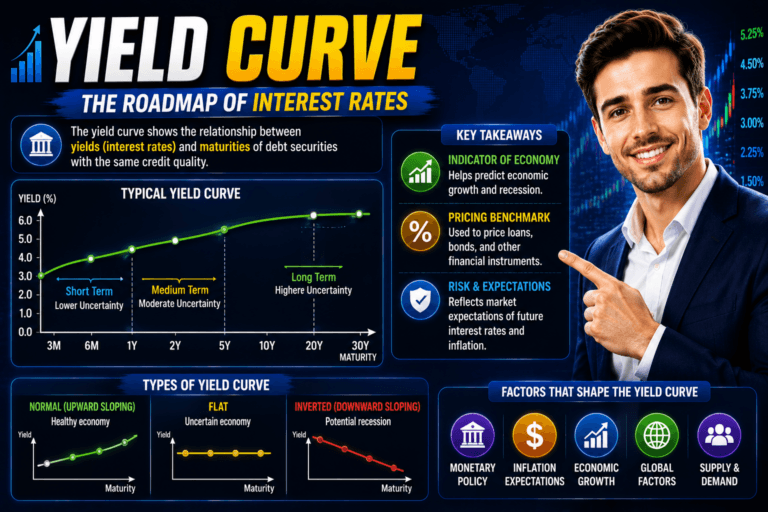
A yield curve is one of the most watched charts in finance.
It shows the relationship between bond yields and their maturities. In simple words, it tells us how much return investors expect from bonds with different time periods.
For example, a 1-year government bond may offer one yield, while a 10-year government bond may offer a different yield. When these yields are plotted on a graph, we get the yield curve.
What is a Yield Curve?
A yield curve is a line that plots interest rates or bond yields on the vertical axis and maturity periods on the horizontal axis.
The bonds used are usually of the same credit quality. Most of the time, government bonds are used because they are considered relatively safer and help show the general interest rate structure in the economy.
So, a yield curve may show yields for:
1-year bond
2-year bond
5-year bond
10-year bond
30-year bond
By looking at the curve, investors can understand what the market expects about interest rates, inflation, and economic growth.
Simple Example
Suppose government bond yields are as follows:
1-year bond yield: 5.5 percent
2-year bond yield: 6 percent
5-year bond yield: 6.8 percent
10-year bond yield: 7.2 percent
30-year bond yield: 7.5 percent
Here, longer maturity bonds are giving higher yields than shorter maturity bonds.
This creates an upward-sloping yield curve.
This is considered a normal yield curve because investors usually demand higher returns for lending money for a longer period.
Why?
Because longer periods carry more uncertainty. Inflation may rise, interest rates may change, and economic conditions may shift.
So, investors ask for extra return to take that longer-term risk.
Real Life Context
Think of it like lending money to a friend.
If your friend says, “I will return your money next month,” you may be comfortable with a lower return.
But if your friend says, “I will return your money after 10 years,” you will probably ask for a higher return because a lot can change in 10 years.
The same logic works in the bond market.
A short-term bond usually has less uncertainty. A long-term bond has more uncertainty. That is why long-term bonds often carry higher yields.
The yield curve captures this difference in one chart.
Types of Yield Curves
A yield curve does not always look the same. Its shape changes depending on market expectations.
Normal Yield Curve
A normal yield curve slopes upward.
This means long-term yields are higher than short-term yields.
It usually shows that investors expect economic growth, inflation, or higher future interest rates.
Flat Yield Curve
A flat yield curve means short-term and long-term yields are almost the same.
This can happen when the market is uncertain. Investors may not be sure whether interest rates will rise or fall in the future.
A flat curve is often seen as a transition phase.
Inverted Yield Curve
An inverted yield curve slopes downward.
This means short-term yields are higher than long-term yields.
It can be a warning signal because it may show that investors expect slower growth or lower interest rates in the future.
In many cases, markets pay close attention to an inverted yield curve because it has often been linked with recession concerns.
Why the Yield Curve Matters
The yield curve is useful because it gives a quick view of market expectations.
Banks, investors, companies, and policymakers watch it closely.
Banks use it because they often borrow short-term and lend long-term. If the yield curve is steep, banks may earn better margins. If the curve is flat or inverted, lending profitability can come under pressure.
Investors use the yield curve to decide whether short-term or long-term bonds look more attractive.
Companies also track it because borrowing costs are linked to interest rates. If long-term yields rise, long-term loans and bond issues may become more expensive.
Yield Curve and Bond Prices
There is also an important connection between yields and bond prices.
When yields rise, bond prices usually fall.
When yields fall, bond prices usually rise.
This matters more for long-term bonds because they are more sensitive to interest rate changes.
So, if an investor expects interest rates to fall, long-term bonds may become attractive. If the investor expects rates to rise, short-term bonds may feel safer.
Final Thoughts
A yield curve shows how bond yields change across different maturities.
It helps investors understand the market view on interest rates, inflation, and economic growth.
A normal curve usually slopes upward. A flat curve shows uncertainty. An inverted curve may signal concern about future growth.
The simple way to remember it is this:
The yield curve tells us what return investors want for lending money over different time periods.